
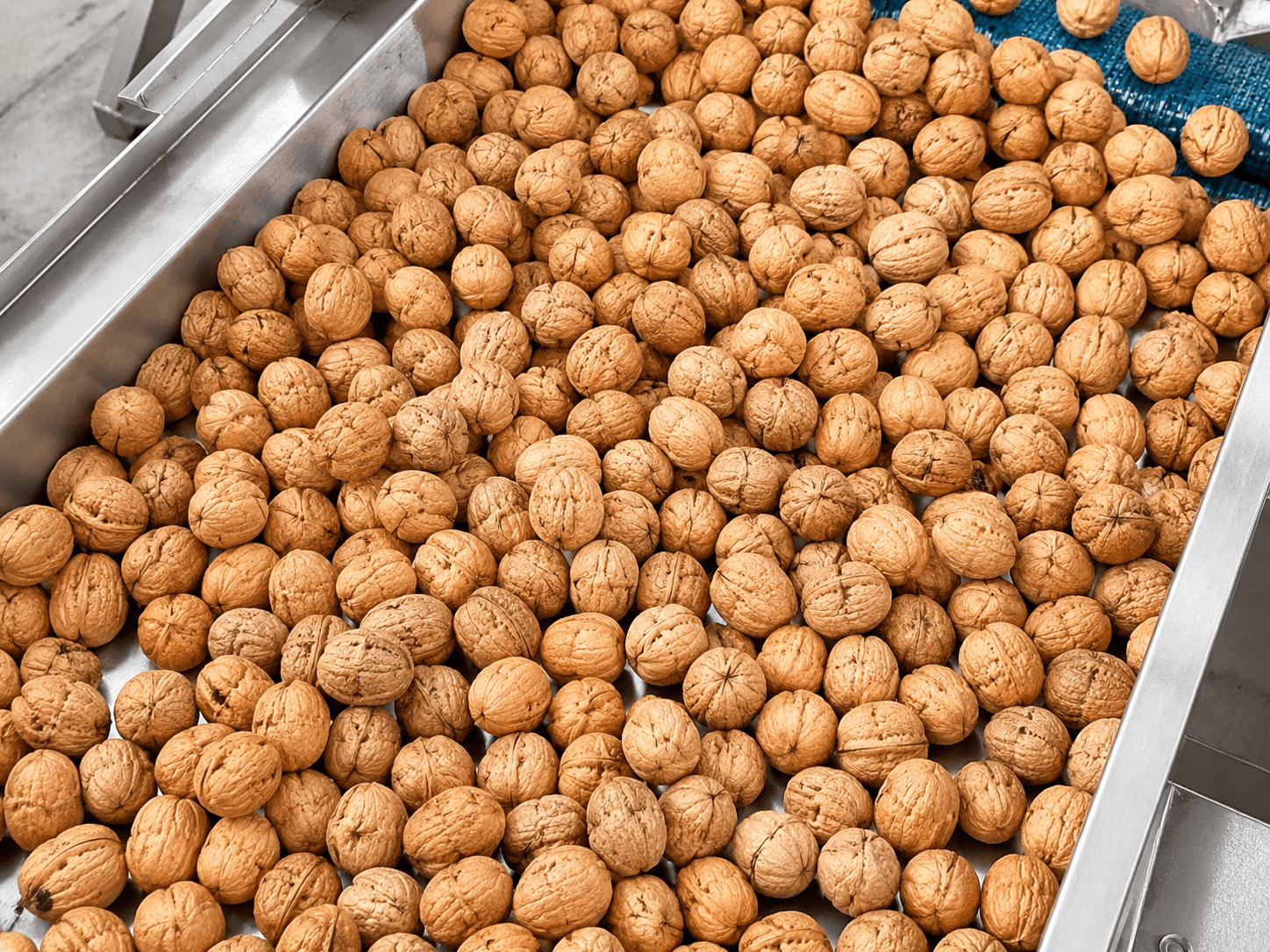
Proper walnut washing is one of the key processing stages that directly affects appearance, safety, storage life, and commercial value.
Many producers underestimate this process, believing that harvesting, drying, and grading are the most important steps. In reality, cleanliness is often one of the first factors buyers use to evaluate the quality of an entire batch.
Cleanliness Creates the First Impression
After harvest, walnuts may contain soil, dust, leaves, green husk residues, organic contaminants, and other impurities. If the product is not washed properly, these materials remain on the shell and visually reduce its quality. Even when the kernel itself is excellent, a dirty shell creates the impression of poor processing and weak quality control. Proper washing is especially important for in-shell walnuts, where buyers directly evaluate the product’s appearance. A clean, light-colored, and uniform shell is perceived as a sign of proper processing, freshness, and professionalism. Such walnuts are easier to present, package, and market as a higher-grade product.
Appearance Directly Affects Price
From a commercial perspective, product cleanliness directly influences value. Buyers compare batches not only by size, moisture level, and kernel yield, but also by appearance. If one batch is clean, uniform, and professionally prepared while another contains dirt, stains, and husk residues, the cleaner batch will almost always have a stronger position during negotiations. A clean product inspires confidence and allows sellers to defend their price more effectively.
A Clean Product Simplifies Processing and Storage
Beyond appearance, proper washing helps reduce future storage and processing issues. Contaminants on the shell can retain moisture, create unpleasant odors, and complicate subsequent operations such as drying, grading, sorting, and packaging. The cleaner the product entering the next stage, the more efficiently equipment operates and the less manual correction is required.
Why Washing Quality Matters
Washing should not be treated as a purely formal step. Simply passing walnuts through water is not enough. Effective washing requires proper water contact, thorough contaminant removal, uniform product flow, and efficient moisture removal before drying. If washing is performed incorrectly, dirt may remain on the product while excess moisture can create additional risks during drying and storage.
Good Washing Builds Buyer Confidence
For processors, properly washed walnuts form the foundation of overall product quality. Clean walnuts are easier to grade, sort, package, and present professionally. As a result, the company receives not just a technically processed product, but one that looks trustworthy and market-ready. In practice, clean walnuts sell more easily and are perceived as more valuable. Buyers recognize that the product has been processed correctly and that the producer controls every stage of production. For this reason, proper washing is not a minor detail—it is an important technological step that affects final price, producer reputation, and repeat sales.