
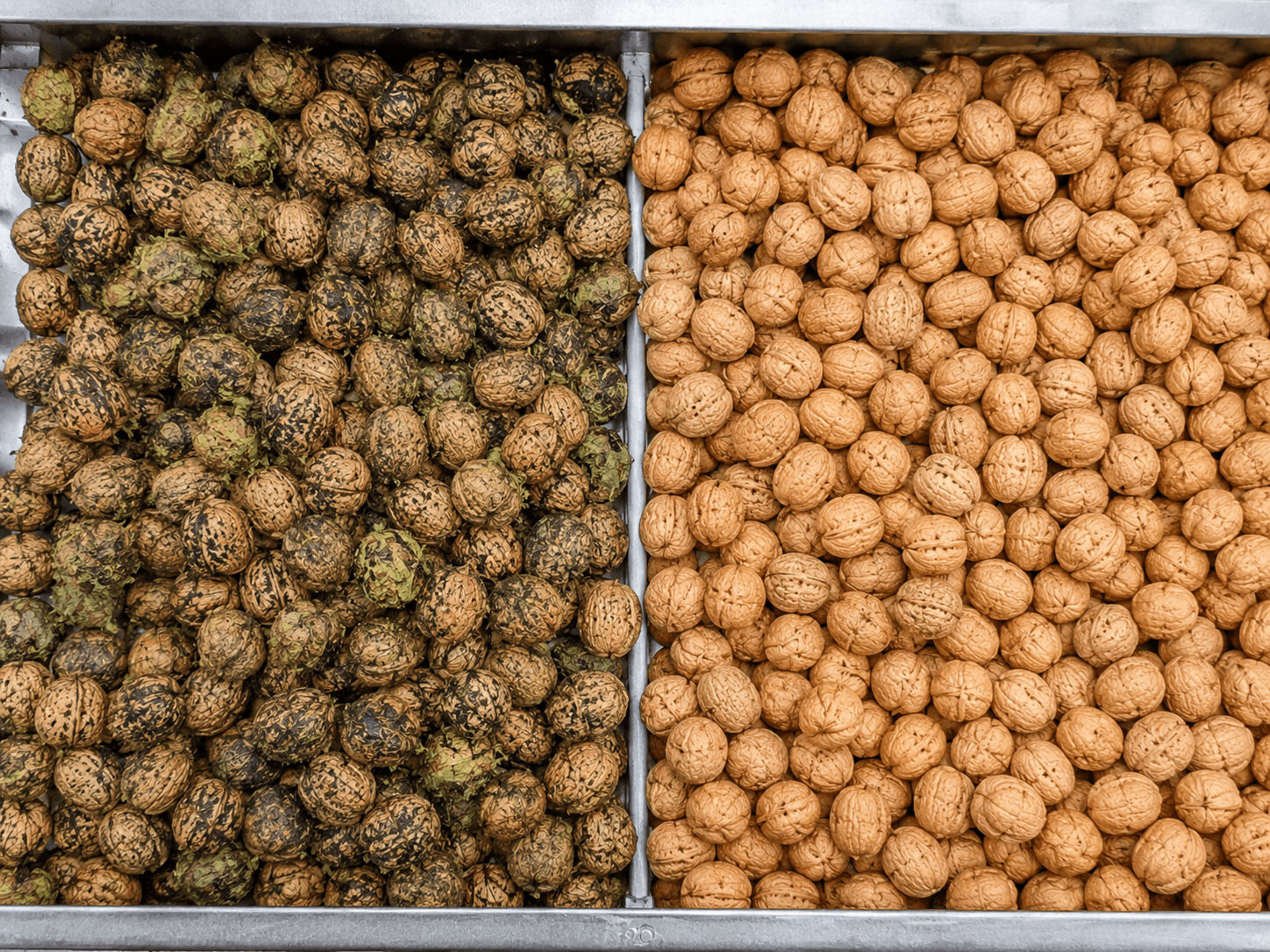
Timely washing of walnuts after harvest is not just a matter of cleanliness. It is one of the key steps that directly affects shell color, kernel quality, storage life, and the final market value of the product.
After harvesting, walnuts remain a living and moisture-rich product. The shells may contain remnants of the green husk, soil, dust, hull juices, and other organic contaminants. If walnuts are left unprocessed for too long, especially in piles or warm conditions, quality deterioration begins: the shells darken, stains appear, the risk of mold increases, and the kernels may lose their light color.
The First Hours After Harvest Are Especially Important
Studies show that a significant portion of walnut quality loss occurs within the first hours after harvest, particularly in high temperatures. In professional processing, washing is never considered a separate operation that can be postponed. The optimal process is as follows: harvest, transport to the processing line, remove the green husk, wash the walnuts, and begin drying. As a practical guideline, walnuts should ideally be washed within the first 6–9 hours after harvest. If logistics are challenging, the minimum goal is to process the walnuts and begin drying within 24 hours.
Why Washing Should Not Be Delayed
It is important to understand that washing should take place after the green husk has been removed, but walnuts should never be soaked or left wet. Water should remove dirt, husk residues, and juices, after which the product should immediately proceed to moisture removal and drying. If washing is delayed, dirt and hull juices become more deeply embedded in the shell. Even thorough washing may no longer restore the walnut’s clean and light appearance. As a result, the batch may look less marketable even if the internal quality remains good.
Appearance Directly Affects Market Value
This has a direct impact on sales. Buyers first notice the appearance of a batch: shell color, cleanliness, uniformity, and the absence of stains. Clean walnuts that have been washed promptly are perceived as a higher-grade product. Such walnuts are easier to sell, easier to price competitively, and better suited for export or premium packaging.
Clean Walnuts Simplify Processing
Timely washing also helps the entire processing line operate more efficiently. Cleaner walnuts enter sizing equipment, color sorters, and inspection tables. Less dirt enters the machinery, less manual rework is required, and the final batch becomes more uniform and commercially attractive.
Quality Begins Immediately After Harvest
In practice, the conclusion is simple: every hour after harvest matters. The faster walnuts move through cleaning, washing, and drying, the greater the chance of preserving a light shell color, high-quality kernels, and strong market value. For professional processors, timely washing is not an additional operation—it is an essential part of quality management.