
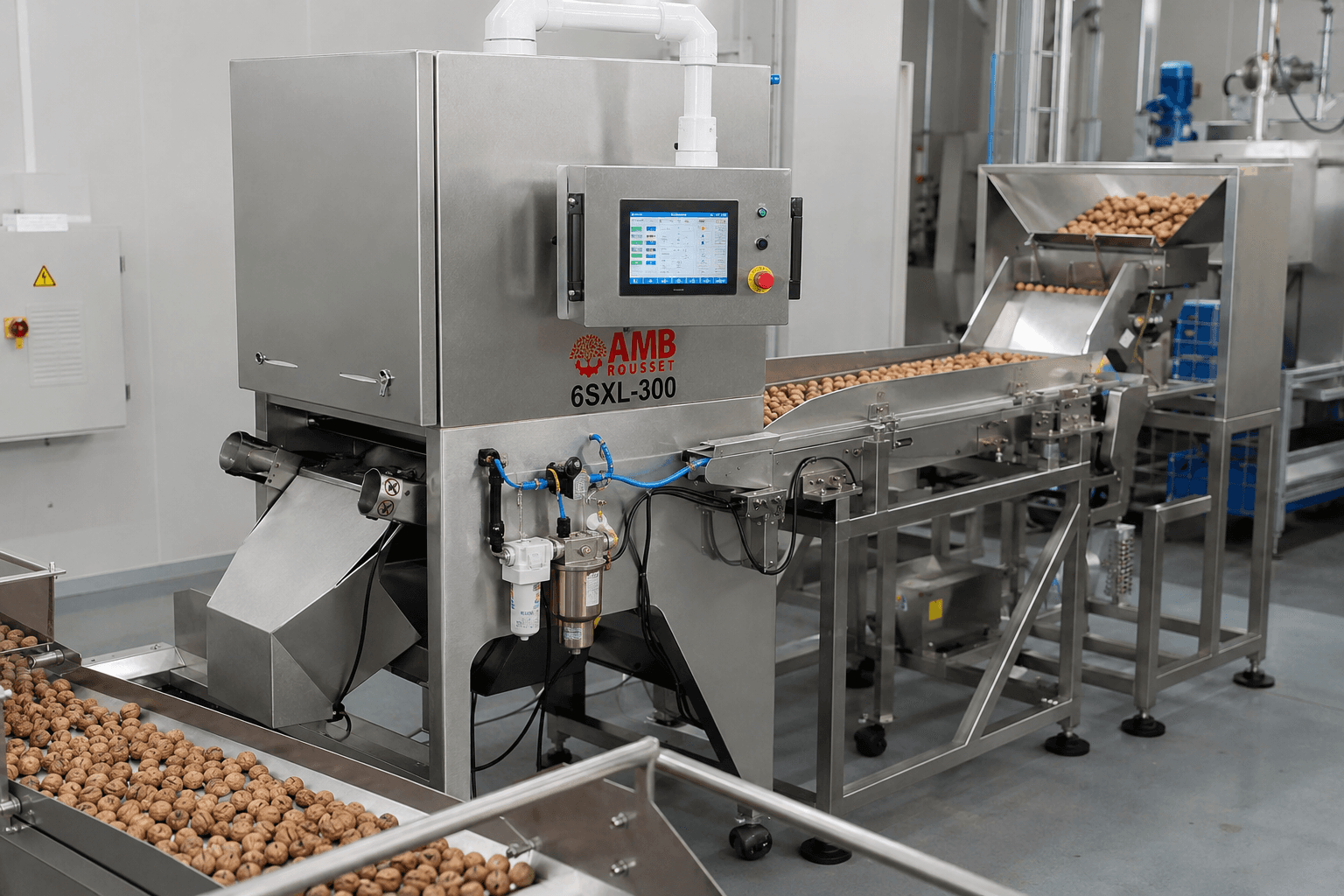
In walnut processing, sizing and color sorting perform different but complementary functions. Sizing separates walnuts by size, while a Color Sorter helps achieve a higher commercial grade by removing defects that cannot be effectively eliminated through mechanical sorting alone.
Color Sorters Simplify Final Quality Inspection
A Color Sorter significantly reduces the workload at the inspection table. After optical sorting, operators receive a much cleaner and more uniform product with fewer defective walnuts, dark kernels, shell fragments, and other defects. This allows employees to focus on final quality control rather than spending time removing obvious defects. Their role becomes more precise: removing what the Color Sorter may have missed and bringing the batch to the required commercial standard.
Sizing Improves Color Sorting Accuracy
After sizing, walnuts are already separated into fractions. This is an important stage because a uniform product size allows the Color Sorter to work more accurately and consistently. When evenly sized product enters the machine, cameras and recognition systems can better detect color variations, damage, darkening, shell fragments, and other unwanted elements.
Effective Removal of Defects and Foreign Material
Color Sorters are particularly useful for walnut kernel sorting. They help separate light kernels from dark ones and remove burnt, moldy, damaged, or oxidized pieces. The equipment can also effectively reject shell fragments, partition pieces, and foreign materials that differ from the main product in color or shape.
Consistent Quality Without Human Variability
The main advantage of a Color Sorter is consistency. Manual sorting depends on worker experience, attention, and fatigue. Results may vary throughout the shift. An optical sorter delivers the same level of performance throughout the process, provided it is correctly adjusted and supplied with product evenly.
Why Export Markets Demand Better Sorting
For export-oriented businesses, product appearance is extremely important. Buyers evaluate not only taste and moisture content but also color uniformity, cleanliness, and the absence of defective kernels. The cleaner and more consistent the product, the higher its commercial value and the lower the risk of customer complaints.
Color Sorters Work Best as Part of a Complete Processing Line
It is important to understand that a Color Sorter does not replace the entire processing line. It cannot correct poor drying, improper storage, or severe kernel damage caused at earlier stages. Its purpose is final precision sorting and quality enhancement of an already prepared product. The best results are achieved when cleaning, drying, sizing, and mechanical sorting have been properly performed before the product reaches the Color Sorter.
Higher Throughput with Less Manual Labor
In practice, Color Sorters perform a tremendous amount of work, especially where consistent quality and high throughput are required. They reduce dependence on manual labor, speed up processing, minimize errors, and help create a higher-value product category.
An Investment That Pays for Itself
Although a Color Sorter is a significant investment, it typically justifies its cost when a processing line operates at normal capacity. Achieving consistent quality through manual sorting requires a large workforce, particularly at higher processing volumes. This creates ongoing expenses related to wages, shift management, quality control, and human error. A Color Sorter performs most of this work automatically by removing a substantial share of defective product and reducing pressure on personnel. As a result, fewer workers are required for primary sorting, while inspection staff can focus on final quality control. The machine pays for itself not only through labor savings but also through more consistent quality, fewer mistakes, and the ability to produce a higher commercial grade product.
Technology That Increases Product Value
A properly configured Color Sorter is far more than an additional machine in the production line. It is a tool that directly affects product appearance, customer confidence, and processing profitability. For modern walnut producers, especially those supplying export markets, this technology is no longer a luxury but a practical necessity.